KYC Verification at Bitcoin ATMs in Switzerland: What to Expect and What You Need
Buying Bitcoin with cash at a Bitcoin ATM does not require you to open a traditional cryptocurrency exchange account or install the operator’s app. However, that does not make the transaction anonymous. At the Bitcoin ATMs featured on our website, a valid ID is required to verify your identity when buying or selling cryptocurrency.
How does KYC work at a Bitcoin ATM, which ID should you bring, and why are these procedures used in Switzerland? Below, we explain the entire process step by step.
What does KYC mean at a Bitcoin ATM?
KYC stands for Know Your Customer. The term refers to procedures that allow an operator to verify the identity of a person using a financial service.
KYC is not the name of a single Swiss law. The obligation to identify customers and apply appropriate safeguards arises primarily from rules designed to combat money laundering and terrorist financing.
In Switzerland, the legal framework includes the Federal Act on Combating Money Laundering and Terrorist Financing—Geldwäschereigesetz (GwG), known in English as the Anti-Money Laundering Act (AMLA). The rules also apply to certain services involving the trading and transfer of cryptocurrencies.
In practice, KYC procedures help establish who is carrying out a transaction, reduce the risk of Bitcoin ATMs being used for money laundering, and allow suspicious transactions to be subject to additional checks.
Do you need to show ID at a Bitcoin ATM in Switzerland?
For the Bitcoin ATMs featured on our website— yes.
Under the operator’s current policy, a valid ID must be used to verify your identity whenever you buy or sell cryptocurrency, regardless of the transaction amount. The ID is scanned directly at the Bitcoin ATM.
However, this operator policy should not be confused with the general statutory threshold that applies in Switzerland.
Swiss regulations set a threshold of CHF 1,000 for identifying parties in certain occasional cryptocurrency exchange transactions. When buying or selling virtual currencies for cash, operators must also implement measures to prevent circumvention of this threshold through linked transactions carried out within a specified time period.
An operator may, however, apply stricter verification rules than the statutory minimum. For this reason, the Bitcoin ATMs featured on this page currently require an ID for every transaction.
Can you avoid KYC by splitting a transaction into smaller amounts?
The CHF 1,000 threshold should not be treated as a way to avoid verification.
For cash transactions involving the purchase or sale of cryptocurrency, linked transactions carried out within a specified period are also taken into account. This is intended to prevent a larger transaction from being deliberately split into a series of smaller ones.
At the Bitcoin ATMs featured on this page, the rule is even simpler: under the operator’s current policy, an ID is scanned for every transaction, regardless of the amount.
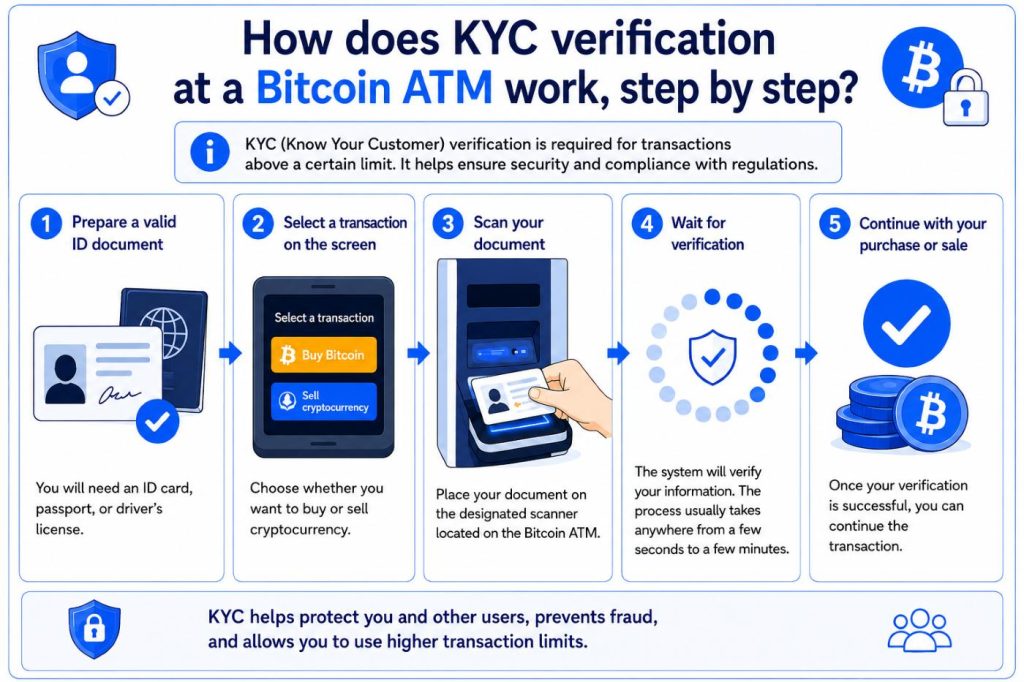
How does KYC verification work at a Bitcoin ATM, step by step?
Verification takes place directly at the Bitcoin ATM and does not require you to create an online account in advance.
1. Bring a valid ID
Before visiting a Bitcoin ATM, bring a valid ID, such as an identity card or passport.
You can find the nearest Bitcoin ATM on our map of Bitcoin ATMs in Switzerland, which provides up-to-date addresses and details for each location.
2. Select the transaction on screen
At the Bitcoin ATM, choose whether you want to buy or sell cryptocurrency, then follow the instructions shown on the screen.
3. Scan your ID
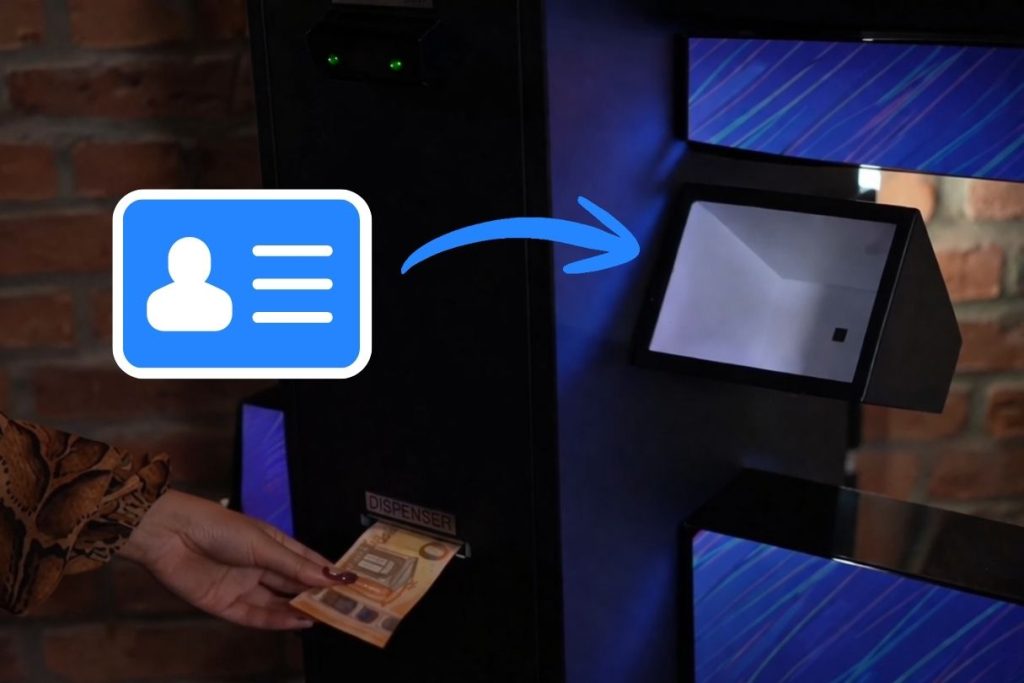
Place the document flat on the designated scanner on the Bitcoin ATM. Make sure you use the document reader, not the QR code scanner.
4. Wait for verification
In most cases, verification is automatic. If the document is scanned incorrectly or the information needs an additional check, the transaction may be put on hold until the issue is resolved.
5. Continue with your purchase or sale
Once the required verification is complete, you can continue the transaction. When buying, provide the address of your own wallet and insert cash. When selling, send the cryptocurrency as instructed; once the transaction is confirmed, you can collect your cash.
If you plan to sell, see our detailed guide on how to sell cryptocurrency and withdraw cash at a Bitcoin ATM.
Do I need to create an account or install an app?
No. KYC does not mean you need to create a user account.
At the Bitcoin ATMs described here, you can use your own compatible cryptocurrency wallet. The operator does not require you to create a conventional exchange account or install its app. You must, however, complete the required identity verification for the transaction.
This distinction is important:
No account registration ≠ no KYC verification.
You may therefore have no username, password or user account and still be properly identified for a specific transaction.
Why is your wallet also checked when you use a Bitcoin ATM?
Swiss AML rules relating to blockchain transactions go beyond checking your ID. It may also be necessary to determine whether the customer actually controls the cryptocurrency wallet used for the transaction.
This helps prevent situations where a verified customer sends funds directly to a wallet belonging to an unknown third party.
For this reason, when using a Bitcoin ATM, use your own cryptocurrency wallet and your own address. Do not scan a QR code sent by an unknown person who tells you by phone or messaging app where to send the cryptocurrency.
What data may be collected during KYC?
The data processed depends on the operator, the verification procedure and the circumstances of the transaction.
During verification, identification data contained in the document, information about the transaction and other data required by security and AML procedures may be processed.
In certain circumstances, the operator may also be required to retain additional information or provide it to the relevant authorities.
Before using a Bitcoin ATM, it is therefore worth reviewing the operator’s current terms and information on how your data is processed.
What happens if KYC verification fails?
A failed verification does not necessarily mean there is a problem with the transaction itself. It may be caused by the document being positioned incorrectly, too little time being allowed for scanning, or a required page of the document not being scanned.
If the system cannot verify the information or the transaction requires additional AML review, the operator may put the transaction on hold and ask for additional information.
In this situation, it is worth keeping:
- the transaction confirmation or transaction ID
- the date and approximate time of the transaction
- the Bitcoin ATM location
- the document used for verification
Support staff may also ask about the purpose of the transaction, the recipient of the funds, or other information needed for the AML review.
KYC vs. AML: What’s the Difference?
These terms are often used together, but they do not mean the same thing.
AML (Anti-Money Laundering) refers to the broader system of laws, procedures and controls designed to prevent money laundering and terrorist financing.
KYC (Know Your Customer) is one part of that system and focuses primarily on establishing and verifying a customer’s identity.
In practice, a Bitcoin ATM operator may first carry out standard KYC verification and then apply additional AML procedures if a particular transaction requires further review.
Does KYC mean there is no privacy when using a Bitcoin ATM?
Privacy and anonymity are two different things.
When using a Bitcoin ATM, you do not necessarily need to create a public profile, open an exchange account or install an additional app. However, an operator subject to AML obligations must still hold certain information in order to meet regulatory requirements.
Bitcoin ATMs in Switzerland should therefore not be presented as a way to buy cryptocurrency completely anonymously.
How should you prepare for your first transaction?
Before going to a Bitcoin ATM, have a valid ID, your own cryptocurrency wallet, and the correct wallet address or QR code ready. Also check the ATM’s location, opening hours, supported currencies and current fees.
If you are using a Bitcoin ATM in Zurich, you can also visit our page about Bitcoin ATMs in Zurich, where you will find location details and opening hours.
One available location is the Bitcoin ATM at Limmatstrasse 197 in Zurich, inside the Quellen kiosk.
If you plan to sell cryptocurrency and collect cash, it is also worth checking whether the required cash currency is available at the selected Bitcoin ATM.
Can KYC rules in Switzerland change?
Yes. Swiss anti-money laundering regulations are updated periodically, as are the procedures used by Bitcoin ATM operators.
For this reason, it is worth regularly checking the latest information on transaction limits, identification methods and any additional requirements.
It is also important to distinguish between the general requirements of Swiss law and the procedures applied by a specific operator. An operator may apply stricter rules than the minimum required by law.
Summary
KYC verification is now a standard part of using the Bitcoin ATMs featured on our website. You do not need to create an account or install an app in advance, but you must verify your identity with a valid ID when buying or selling cryptocurrency.
It is important to distinguish the minimum requirements under Swiss AML rules from the policies adopted by a specific operator. Swiss regulations include a CHF 1,000 threshold for certain cryptocurrency exchange transactions, whereas the operator of the Bitcoin ATMs discussed here currently requires an ID for every transaction.
Before your visit, have your own wallet and a valid ID ready, and check the latest information for the Bitcoin ATM you plan to use. This should help both the verification process and the transaction go more smoothly.
Legal information and operator policies current as of August 2026. This material is for informational purposes only and does not constitute legal advice.
Frequently asked questions
Yes, at the Bitcoin ATMs featured on this page. Under the operator’s current policy, a valid ID is required for both purchases and sales, regardless of the transaction amount.
Not at the Bitcoin ATMs discussed here. CHF 1,000 is a relevant threshold under Swiss rules for certain cryptocurrency transactions, but the operator currently requires ID verification for every transaction.
Bring a valid ID, such as an identity card or passport. The document must be suitable for verifying your identity.
No. You do not need to create an account or install the operator’s app before using the Bitcoin ATMs discussed here. KYC verification takes place at the Bitcoin ATM during the transaction.
You should not. Use your own cryptocurrency wallet and make sure you control the address used for the transaction.
Place the document flat on the correct reader and try again, following the on-screen instructions carefully. If verification still fails, keep the transaction number and contact the operator’s official support team.