Blockchain Basics: How Does Blockchain Technology Work?
Blockchain is one of the most important technologies to have developed alongside the cryptocurrency market. It is most commonly associated with Bitcoin, but its applications extend far beyond digital money. Blockchains can be used, among other things, to store data, process payments, create digital agreements and verify ownership.
For beginners, blockchain may seem complicated. In reality, its basic principle is relatively simple: information is recorded in a sequence of blocks that are linked together and shared with network participants.
In this guide, we explain what blockchain is, how it works, and why the data stored in it cannot be easily altered.
Blockchain: What Does the Name Actually Mean?
The word “blockchain” can be translated as “chain of blocks.” It is a type of digital ledger in which information is grouped into blocks and then linked together in the correct order.
Each new block contains, among other things, data about completed operations and a special identifier that refers to the previous block. This creates an ordered chain of information.
Blockchain can be compared to a ledger to which new pages are regularly added. The difference is that copies of this ledger can be stored simultaneously on multiple computers belonging to network participants.
How does information get onto the blockchain?
The process of recording data may vary slightly from one network to another, but the general sequence is similar.
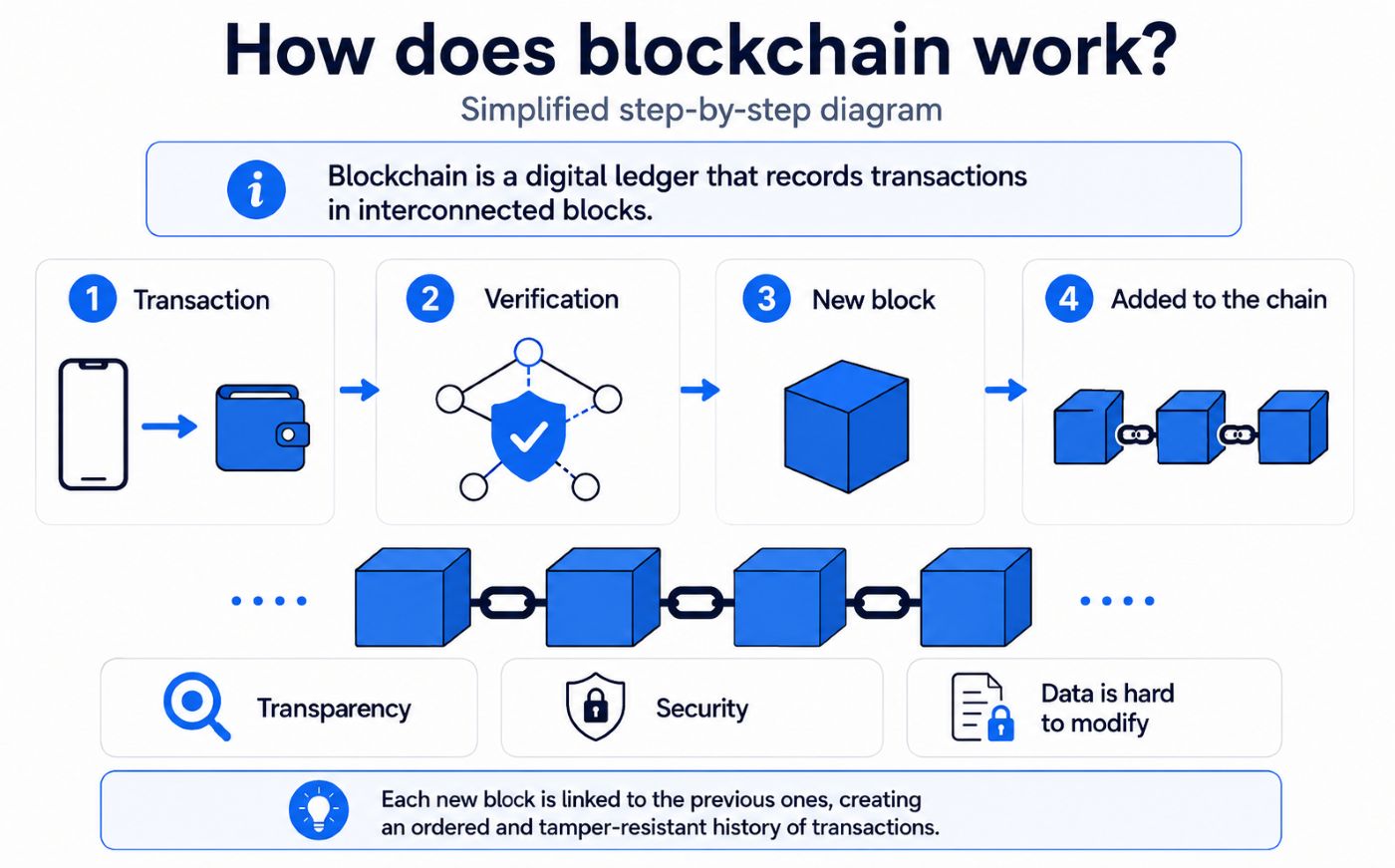
First, a user initiates an operation, such as sending cryptocurrency or executing a smart contract. Information about that operation is sent to the network, where it is verified according to the applicable rules.
Once approved, the operation can be included in a new block together with other operations. The block is then added to the existing chain, and the updated version of the ledger is distributed to network participants.
In simple terms, the process works as follows:
- The user initiates an operation
- The information is sent to the blockchain network
- Network participants verify that it is valid
- Verified operations are grouped into a block
- The new block is linked to the previous blocks
- The updated ledger is stored across the network
What are the components of a blockchain?
To understand how the technology works, it’s helpful to learn about a few of its basic components.
Data block
A block is a digital collection of information. In the case of a cryptocurrency network, it may contain a list of completed transactions, the times they were confirmed, and the technical data needed for the system to continue operating.
Each blockchain sets its own rules regarding block size, the type of data stored, and the frequency with which blocks are created.
Links Between Blocks
A new block refers to a block created earlier. In this way, the successive entries in the ledger form a chronological structure.
Changing information in an older block would affect its links to subsequent blocks. This is one reason why tampering with the history of an established blockchain is so difficult.
Cryptographic hash
A hash, also known as a cryptographic hash, is a string of characters generated from specific data. It can be compared to a digital fingerprint.
Even a small change to the input data produces a different hash. This allows the network to detect that the contents of a block have been modified.
A hash is not the same as encryption. Its purpose is not to conceal information, but to create a unique digest that can be used to verify data integrity.
Network nodes
Nodes are computers or other devices connected to the blockchain. They can store a copy of the ledger, relay information about new operations and verify that the data is valid.
Not every node has to perform the same tasks. Some store the network's complete history, while others access only a limited amount of information.
Why Does a Blockchain Not Need a Single Central Database?
In a traditional system, a database is usually managed by a specific institution, company or administrator. That entity decides who can access it and how changes can be made.
In a decentralized blockchain, copies of the ledger are stored by many independent participants. Therefore, there is no single central server on which the entire system depends.
Decentralization can make a network more resilient to failures and attempts at tampering. If one computer fails, the entire ledger is not lost because copies are also stored on other devices.
Not every blockchain is fully decentralized. The level of decentralization depends on factors such as the number of participants, the method used to validate operations and how control over the network is distributed.
How Does the Network Agree on the Correct Version of the Data?
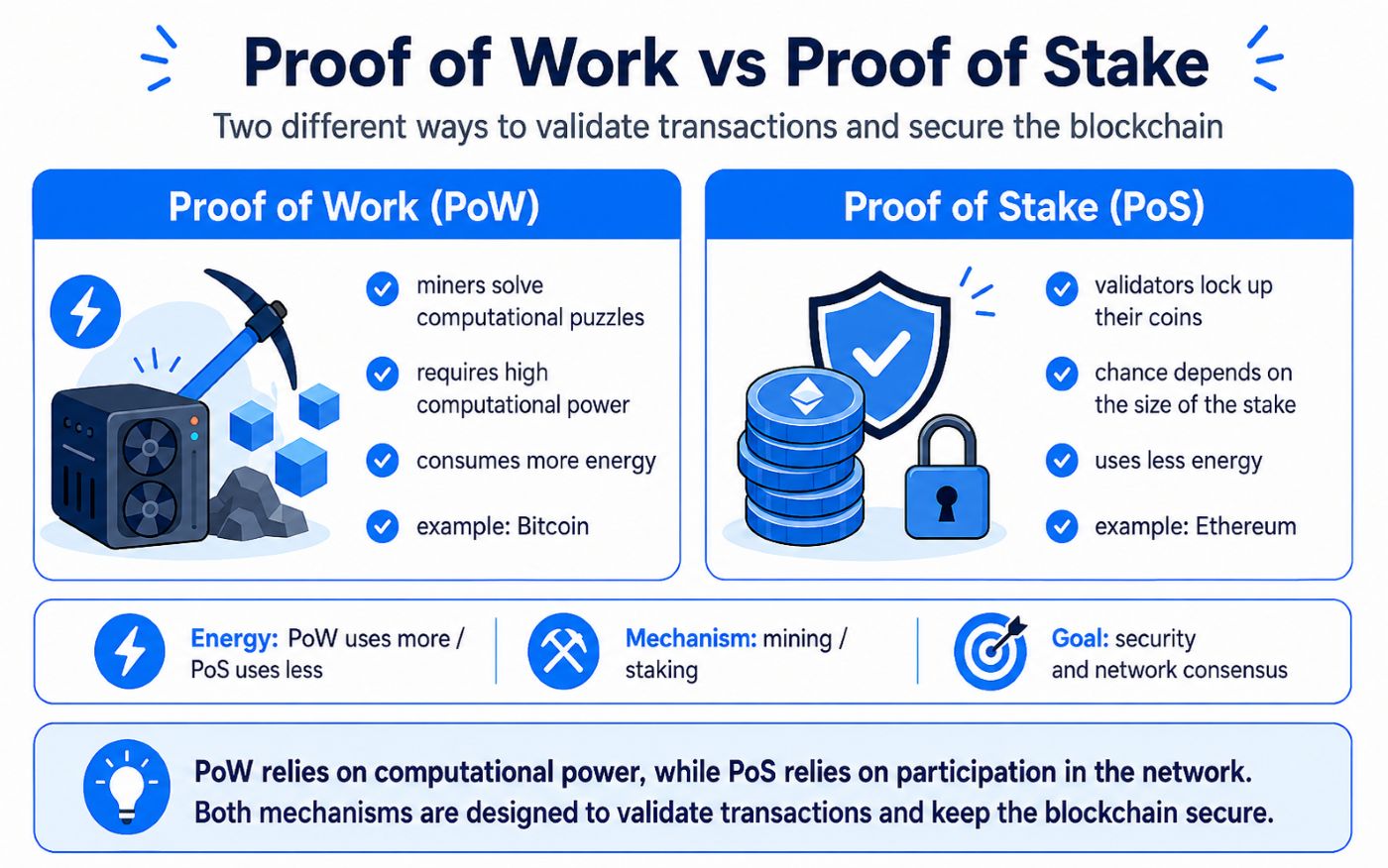
Blockchain participants must determine which transactions are valid and what the current state of the ledger is. Consensus mechanisms are used for this purpose.
A consensus mechanism can be described as a set of rules by which a network reaches agreement without the need for a single central administrator.
The best-known mechanisms include:
- Proof of Work, based on computational work performed by miners
- Proof of Stake, in which participation in transaction validation is linked to owning and locking up specific assets as stake
- mechanisms used in private networks, where only approved participants are authorized to validate operations
Individual solutions differ in terms of speed, energy consumption, costs, and the degree of decentralization.
How Are Blockchain and Cryptocurrencies Connected?
Cryptocurrencies use blockchain as a ledger of balances and completed transactions. This allows the network to verify that a user holds the relevant assets and is not trying to spend the same units more than once.
Blockchain does not store coins in the same way that a computer stores a file. Instead, it records information that identifies which assets are assigned to specific addresses.
Access to cryptocurrencies is controlled using cryptographic keys. A public key—or an address generated from it—can be used to receive funds. A private key is used to authorize transactions and should remain known only to the owner.
Is every blockchain publicly accessible?
Blockchains can have different access rules. They are most commonly divided into public and private networks, although models between these two categories also exist.
Public Networks
A public blockchain is open to a wide range of users. Anyone can usually view recorded transactions, run their own node or use applications operating on the network.
Examples include Bitcoin and Ethereum.
Public networks typically prioritize transparency and resistance to censorship, as well as reducing the control of any single entity.
Permissioned Networks
A private blockchain is controlled by a specific organization or a closed group of participants. Access to data and the ability to validate operations may require authorization.
Such solutions can be used by companies, financial institutions, or organizations that want to leverage distributed ledger technology while maintaining control over access.
Consortium Blockchains
A consortium blockchain is managed by several cooperating entities. None of them has complete, independent control over the system.
This model can be used in industries where several companies need a shared database but do not want to hand control of it to a single operator.
What Makes Blockchain Secure?
Blockchain security does not come from a single mechanism. It results from a combination of cryptography, distributed data storage and consensus rules.
The main security features include:
- linking consecutive blocks with cryptographic hashes
- storing copies of the ledger on multiple devices
- validating operations according to predefined rules
- using digital signatures
- requiring network approval before new data is added
However, this does not mean that every blockchain-based system is automatically completely secure. Vulnerabilities may exist in applications, smart contracts, wallets or the way private keys are stored.
Security also depends on the design of a particular network and the number of independent participants who help secure it.
Can data stored on the blockchain be deleted?
It is often said that data recorded on a blockchain is immutable. In practice, this means that changing it later is very difficult and may require taking control of a significant part of the network.
However, immutability should not be treated as an absolute guarantee. In some situations, blocks may be reorganized, the protocol may be updated or the network may split.
On public, widely distributed blockchains, altering older records becomes increasingly difficult as more blocks are added. The more blocks that have been added after a given operation, the greater the confidence that it will remain part of the network's history.
What are smart contracts?
A smart contract is a program that runs on a blockchain. It automatically executes specific instructions when its predefined conditions are met.
A smart contract can, for example:
- transfer digital assets
- swap one token for another
- distribute funds across several addresses
- record the result of a vote
- manage a loan
- manage ownership of a digital item
A smart contract does not have to be a contract in the traditional legal sense. It is primarily computer code executed by the network.
Its advantage is automation, but errors in the code can lead to losses. For this reason, complex contracts should be thoroughly tested and audited.
How Is Blockchain Used Beyond Cryptocurrencies?
Blockchain technology can be used wherever a shared, verifiable ledger of information is needed.
Supply Chain Tracking
Blockchain can record the successive stages involved in transporting and producing goods. This makes it possible to verify a product's origin and trace its journey from the manufacturer to the recipient.
Digital Proof of Ownership
Information about rights to digital or physical assets can be recorded on a blockchain. Examples include tokens representing collectibles, shares or other property rights.
Documents and Certificates
Document hashes can be recorded on a blockchain to verify their authenticity at a later date. This does not require the document's full contents to be made public.
Decentralized Finance
DeFi applications can, among other things, exchange tokens, provide loans and earn interest without relying on a traditional intermediary.
Voting and Organizational Governance
Blockchain can be used to record votes and govern decentralized organizations. The transparency of a public ledger allows participants to verify the results of decisions.
International Payments and Settlements
Some networks allow digital assets to be transferred between users located in different countries. The time and cost of such a transaction depend on the blockchain used.
The Key Advantages of Blockchain Technology
The potential advantages of blockchain include:
- operating without a central administrator
- transparent records on public networks
- resilience to the failure of a single server
- easier verification of transaction history
- the ability to automate processes
- less reliance on certain intermediaries
- global access to the network
The value of each benefit depends on how the specific system is designed.
Blockchain vs. a Traditional Database: Key Differences
A traditional database usually has an administrator who can modify or delete information. It is also often stored on servers owned by a single organization.
A blockchain can distribute copies of the ledger among multiple participants and limit the possibility of one party unilaterally altering the recorded history.
However, this does not mean that blockchain is always better. A regular database may be faster, cheaper, and easier to use. Blockchain makes the most sense when several independent parties need a shared ledger but do not want to entrust full control to a single entity.
Is Blockchain Anonymous?
Blockchain does not always provide anonymity. On many public networks, anyone can view the transaction history associated with a particular address.
An address usually does not include a first or last name, but it may be possible to link it to a specific person based on other data, such as information provided when using a particular service.
For this reason, many blockchains are more accurately described as pseudonymous.
Summary
Blockchain is a distributed ledger in which information is recorded in interconnected blocks. It operates through cryptography, consensus mechanisms and the cooperation of many devices run by network participants.
This technology has enabled the creation of cryptocurrencies, but it can also support smart contracts, digital ownership, payment systems, supply chains, and tools for verifying data authenticity.
Blockchain does not eliminate every risk or replace every traditional database. However, it is a useful solution for systems that require transparency, independent verification and less control by a single administrator.
Frequently asked questions
No. Blockchain is a technology used to store and verify data, while Bitcoin is a cryptocurrency that uses its own blockchain.
It depends on the type of network. A public blockchain can be maintained by many independent participants, while a private network can remain under the control of a single company or a closed group of organizations.
On public networks, most information about blocks and transactions can be viewed using a blockchain explorer. On private blockchains, access to data may be restricted.
A confirmed transaction generally cannot be cancelled in the same way as a traditional bank transfer. Recovering the funds may require the recipient to make a new transaction.
No technology can guarantee complete security. A well-decentralized blockchain can be highly resistant to changes to its history, but risks may still arise in applications, wallets, smart contracts and key storage methods.
Users can prepare some operations offline, but broadcasting them to the network and having them confirmed usually requires an internet connection.
The size of a blockchain increases as more blocks are added. Full nodes may store the entire history, while lighter applications retrieve only the information needed for specific tasks.