Cryptocurrency Mining in Switzerland: How Does It Work and Is It Profitable?
Cryptocurrency mining, often referred to simply as mining, is one of the key mechanisms underpinning Bitcoin and other cryptocurrencies that use Proof of Work. Miners help confirm transactions, secure the blockchain network, and add new blocks to it. In return, they can receive cryptocurrency rewards and transaction fees.
Just over a decade ago, Bitcoin could be mined on an ordinary computer. Today, things are very different. Growing competition, the network’s enormous computing power, and electricity costs mean that professional Bitcoin mining requires specialized hardware.
In Switzerland, electricity prices are especially important because power is one of the largest costs associated with mining. Before buying a mining rig, it is therefore worth calculating carefully whether operating it makes economic sense.
What is cryptocurrency mining?
Cryptocurrency mining is a process used by blockchains that rely on Proof of Work (PoW). Computers participating in the network perform vast numbers of calculations in an attempt to find a solution that allows the next block to be created.
A miner that finds a valid solution can propose a new block. Other participants in the network verify it, and once it is accepted, the block is recorded on the blockchain.
Mining serves several purposes at once:
- confirms and organizes transactions
- helps prevent the same funds from being spent twice
- protects the blockchain from tampering
- enables the issuance of new units of certain cryptocurrencies
- provides financial incentives to those who contribute computing power
In Bitcoin, the miner that earns a block reward currently receives 3.125 BTC plus the transaction fees included in that block. The block reward is reduced roughly every four years through the Bitcoin Halving mechanism.
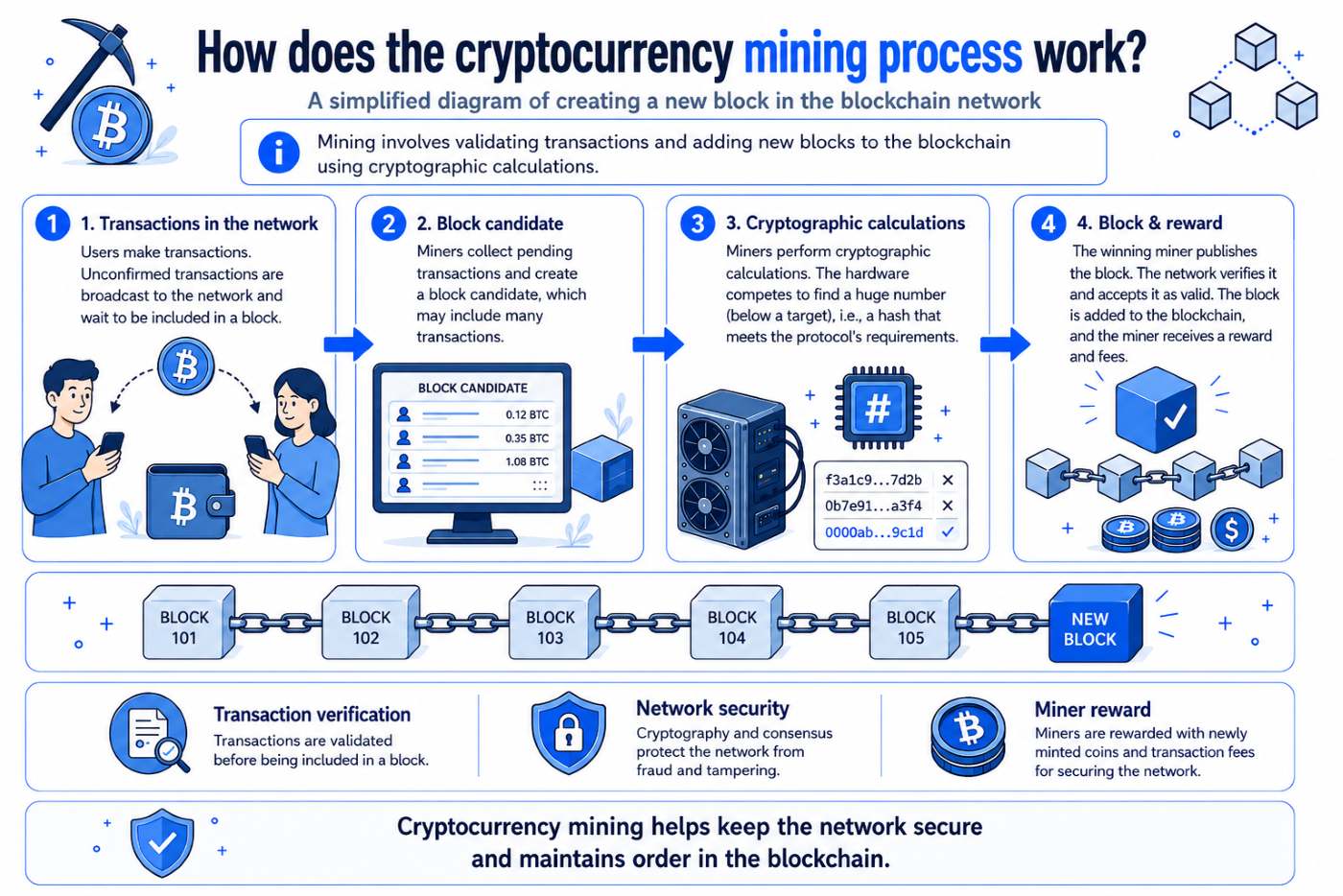
How does the cryptocurrency mining process work?
To put it simply, it can be broken down into a few steps.
- Users submit transactions. Unconfirmed transactions are broadcast to the network and wait to be included in a block.
- Miners create candidate blocks by selecting transactions that may be included in the next block.
- Mining hardware performs cryptographic calculations. It generates an enormous number of hashes in an attempt to find a result that meets the protocol’s requirements.
- The miner that finds a valid solution publishes the block. Other nodes verify it, the block is added to the blockchain, and the miner receives the corresponding reward and transaction fees.
Bitcoin automatically adjusts mining difficulty so that, despite changes in the network’s total computing power, new blocks continue to be produced at roughly the same average rate. This means that adding more mining hardware to the network does not simply cause a proportional increase in the number of bitcoins mined.
Can every cryptocurrency be mined?
No. Traditional mining primarily involves cryptocurrencies that use Proof of Work.
The best-known example is Bitcoin. Other cryptocurrencies may use different algorithms and allow mining using ASICs, graphics cards, or CPUs.
Ethereum is an important example. Older online guides may still explain how to mine ETH with graphics cards, but they are now outdated. Ethereum switched from Proof of Work to Proof of Stake on September 15, 2022, so ETH can no longer be mined using traditional mining. The network is now secured by validators through staking.
What is a cryptocurrency mining rig?
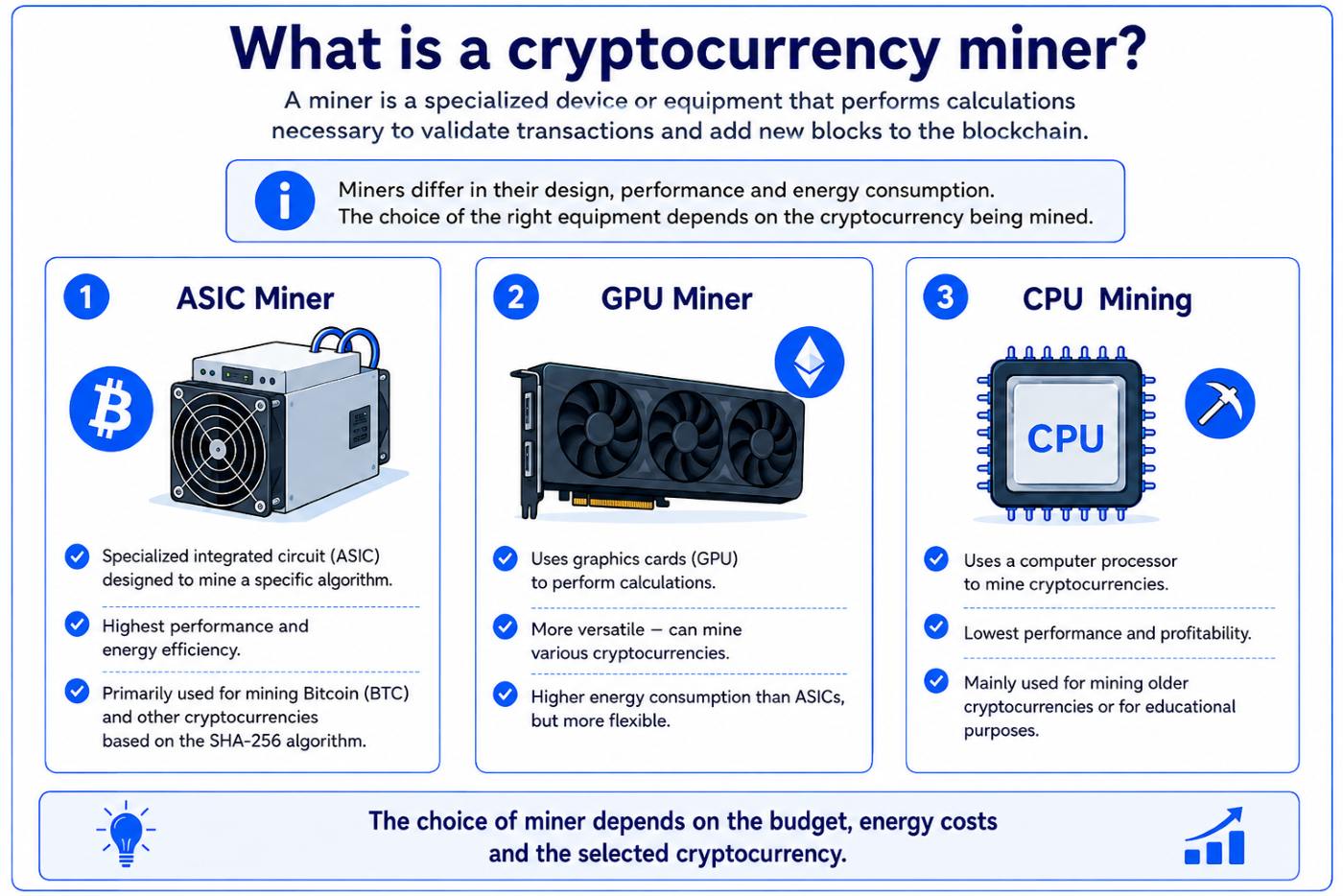
A cryptocurrency mining rig is a device designed to perform the calculations required for mining. It may be a computer using a CPU or graphics cards, but large networks today rely primarily on specialized hardware.
ASIC miner
ASIC (Application-Specific Integrated Circuit) hardware is designed to perform a specific type of computation. For Bitcoin, ASIC miners are optimized for the SHA-256 algorithm.
Today, ASIC miners are the standard hardware used for professional BTC mining. They offer enormous computing power, but also have drawbacks: high purchase costs, heavy electricity consumption, heat and noise, and limited use outside mining.
GPU mining rig
A GPU mining rig uses one or more graphics cards. These setups were popular with home miners for years because cards could be replaced relatively easily and miners could switch between different cryptocurrencies.
GPUs remain useful for certain Proof-of-Work projects, but they are not currently a competitive alternative to standard Bitcoin mining.
CPU mining
Computer processors were used to mine Bitcoin in its early years. Today, their processing power is far too low for BTC. CPU mining remains possible only on certain other networks designed to limit the advantage of specialized hardware.
Bitcoin mining rig vs. a regular computer: what’s the difference?
A regular computer is designed to handle many different tasks. An ASIC miner, by contrast, performs essentially one type of operation, but does so vastly faster and more efficiently.
Therefore, buying a very powerful gaming computer just to mine Bitcoin usually doesn't make economic sense.
You can, however, run a small educational device or a so-called lottery miner to learn the technical basics of the Bitcoin network. With very little computing power, however, the chance of finding a block on your own is extremely low.
How do I start mining cryptocurrencies?
Before setting up a mining rig, it is best to treat mining as a business investment rather than a way to make quick, guaranteed profits.
1. Choose a cryptocurrency
First, check whether the network you have chosen still uses Proof of Work and which mining algorithm it uses. This determines the type of hardware you will need.
2. Calculate your electricity costs
Check the actual price per kWh at your address. In Switzerland, electricity rates can vary significantly between municipalities and energy providers.
3. Choose your hardware
When buying a mining rig, pay particular attention to:
- hashrate
- power consumption
- energy efficiency
- purchase price
- noise level
- power and cooling requirements
The highest hashrate does not always mean the most profitable mining rig. What matters is how much hashrate the machine delivers for each watt of power it consumes.
4. Set up a cryptocurrency wallet
You need a wallet address to receive the cryptocurrency you mine. For larger amounts, consider using a wallet that gives you full control over your private keys.
5. Choose a mining pool
Given the current scale of the Bitcoin network, mining independently, known as solo mining, is highly unpredictable for a small-scale miner.
That is why most participants join a mining pool. A pool combines the computing power of many miners and distributes rewards in proportion to the work contributed, usually after deducting its fee.
6. Monitor performance
Once the mining rig is running, monitor temperatures, power consumption, hashrate, hardware failures, and actual revenue. Profitability can change even when the machine itself continues to operate normally.
Solo mining, mining pool, or cloud mining?
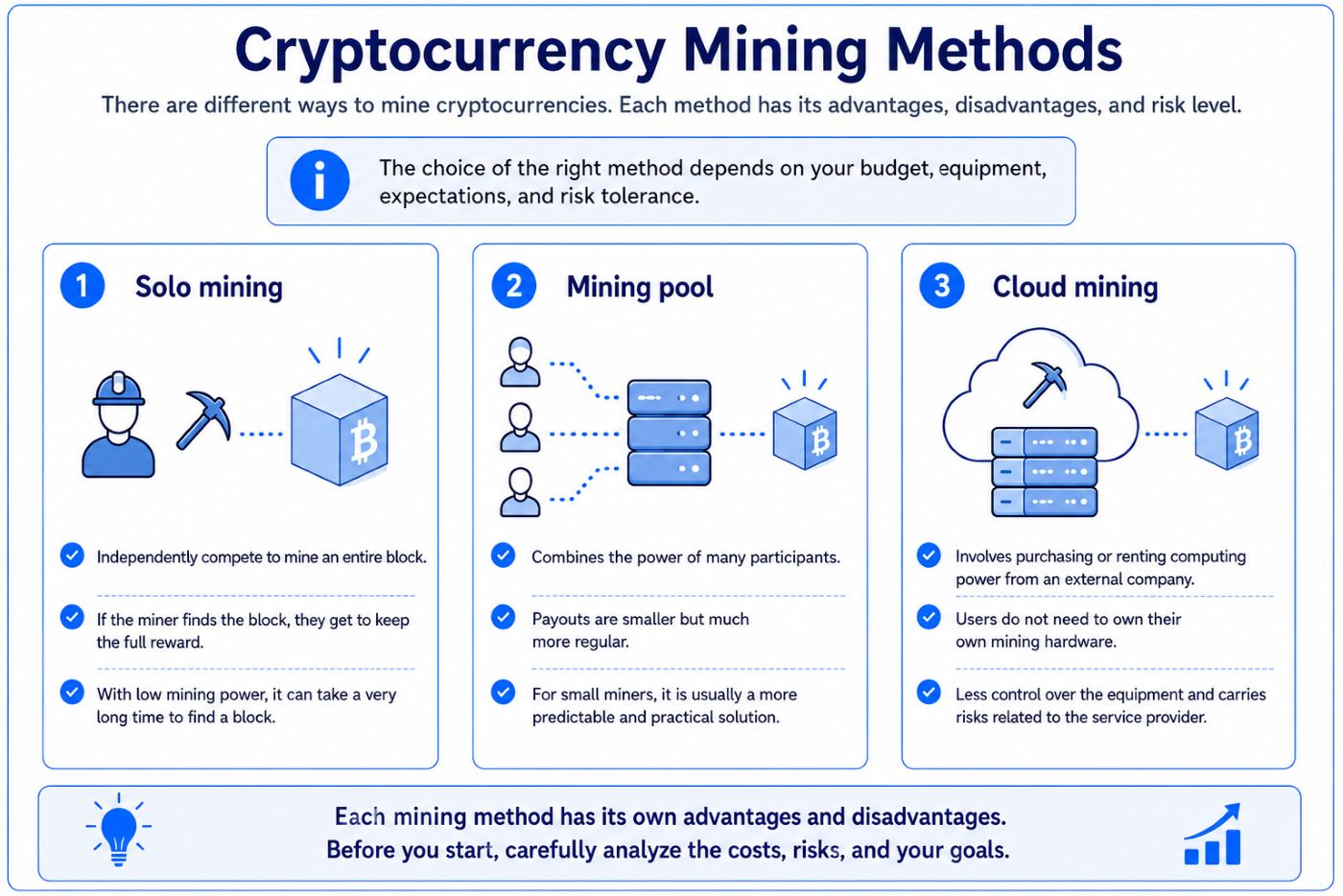
There are three basic ways to participate in mining.
Solo mining means competing on your own to find an entire block. If a miner finds one, they do not have to share the reward with others. With limited hashrate, however, the wait can be extremely long.
A mining pool combines the computing power of many participants. Payouts are smaller, but much more regular. For small-scale miners, this is usually the more practical option.
Cloud mining involves buying or renting computing power from a third-party company. You do not need to own a mining rig, but you give up control over the hardware and take on risks associated with the operator.
When it comes to cloud mining, you should be particularly wary of promises of high or guaranteed returns. Swiss authorities have repeatedly warned against online investment offers promising quick, high returns. FINMA has also conducted investigations into models for financing mining operations through agreements with investors.
Is cryptocurrency mining profitable in Switzerland?
This is the key question for anyone considering buying a mining rig.
Profitability depends mainly on:
- electricity costs
- mining rig efficiency
- current mining difficulty
- total network hashrate
- price of the mined cryptocurrency
- block reward
- transaction fees
- mining pool fee
- cooling and ventilation costs
- breakdowns and maintenance
- hardware depreciation
- taxes
ElCom reports that in 2026 the median total electricity tariff for a typical Swiss household is 27.7 centimes per kWh. The actual cost, however, depends on the municipality, grid operator, and consumption profile.
A simple example illustrates this well.
If a mining rig draws a constant 3.5 kW, over 30 days it will consume approximately:
3.5 kW × 24 hours × 30 days = 2,520 kWh.
Using the median rate of 27.7 Rp./kWh as a rough estimate, electricity alone would cost approximately:
2,520 × 0.277 CHF = 698 CHF per month.
And that is before factoring in the cost of the mining rig, mining pool fees, cooling, maintenance, and taxes.
This does not mean that mining in Switzerland can never be profitable. The economics can look very different for an installation with access to cheaper energy, its own electricity generation, or a practical way to use the heat produced by the equipment. However, at a standard household electricity rate, buying hardware without running the numbers first is very risky.
A simple profitability formula looks like this:
profit = mining revenue – electricity – pool fees – cooling and maintenance – hardware depreciation – taxes.
This calculation needs to be updated regularly because the cryptocurrency price, mining difficulty, and competition across the network all change over time.
Is cryptocurrency mining legal in Switzerland?
Switzerland does not have a general ban on cryptocurrency mining. The Federal Statistical Office even includes mining in its classification of economic activities, while the Federal Tax Administration explains in detail how income from Proof of Work is taxed. It is therefore fair to say that cryptocurrency mining itself is not generally prohibited in Switzerland. A specific mining operation may still be subject to other requirements relating to business activity, electrical installations, buildings, noise, or safety.
The situation may be different if a company accepts client funds, offers investments in mining, or provides other financial services. In that case, the business model must also be assessed under financial-market regulations and any applicable FINMA requirements.
Where should you store mined cryptocurrency?
Mining rewards are paid to the cryptocurrency wallet address you provide.
For smaller amounts, a mobile or desktop wallet may be convenient. For larger holdings, consider a hardware wallet, which can keep private keys isolated from devices that are continuously connected to the internet.
Regardless of the wallet type, the most important thing is to store your seed phrase and private keys securely. Losing them can mean permanently losing access to your cryptocurrency.
Is it worth buying a cryptocurrency mining rig?
For most people in Switzerland, buying a mining rig solely in the hope of easy passive income is not a good starting point.
Mining may make sense if you have:
- a clear and accurate estimate of electricity costs
- access to high-performance hardware
- suitable technical conditions
- a way to dissipate or make use of the heat
- an understanding of the risks posed by changes in the cryptocurrency price and network difficulty
- a long-term operating plan
For someone primarily interested in owning Bitcoin, buying BTC directly may be simpler than purchasing equipment, paying for electricity, and running mining infrastructure. Swiss comparison site moneyland.ch also notes that mining profitability depends on whether the value of the mined bitcoins exceeds electricity costs and the investment in hardware.
Mining nevertheless remains an essential part of Bitcoin. Economic competition between miners allows the network to confirm transactions and secure the blockchain without relying on a single central authority.
Frequently asked questions
Technically, you can participate in mining with very little computing power, but a regular computer is no longer competitive with specialized ASIC miners. Efficient BTC mining requires specialized hardware.
GPUs played an important role in the history of Bitcoin mining, but today they have been replaced by much more efficient ASIC miners. Graphics cards can still be used to mine certain other Proof of Work cryptocurrencies.
No. Ethereum switched to Proof of Stake on September 15, 2022. Traditional ETH mining ended, and the network is now secured by validators.
Power consumption depends on the device. A machine drawing 3.5 kW and running continuously for 30 days consumes approximately 2,520 kWh of electricity. This is why the price per kWh has such a major impact on mining profitability.
Yes. The Swiss Federal Tax Administration (ESTV) states that compensation received from Proof of Work mining is taxable income. If the activity meets the criteria for self-employment, the income may be treated as self-employment income.