What is Bitcoin, and how does it work?
Bitcoin is the world’s best-known cryptocurrency, but it is more than a digital coin whose price fluctuates on exchanges. It is also an independent payment network that lets users transfer value directly to one another—without a bank or any other central intermediary.
Bitcoin lets users send and receive funds online, regardless of where they live or when traditional financial institutions are open. To make a transaction, the main requirements are a cryptocurrency wallet and an internet connection.
How exactly does Bitcoin work, where do new coins come from, and why do people consider them valuable? We explain the key concepts below.
What is Bitcoin?
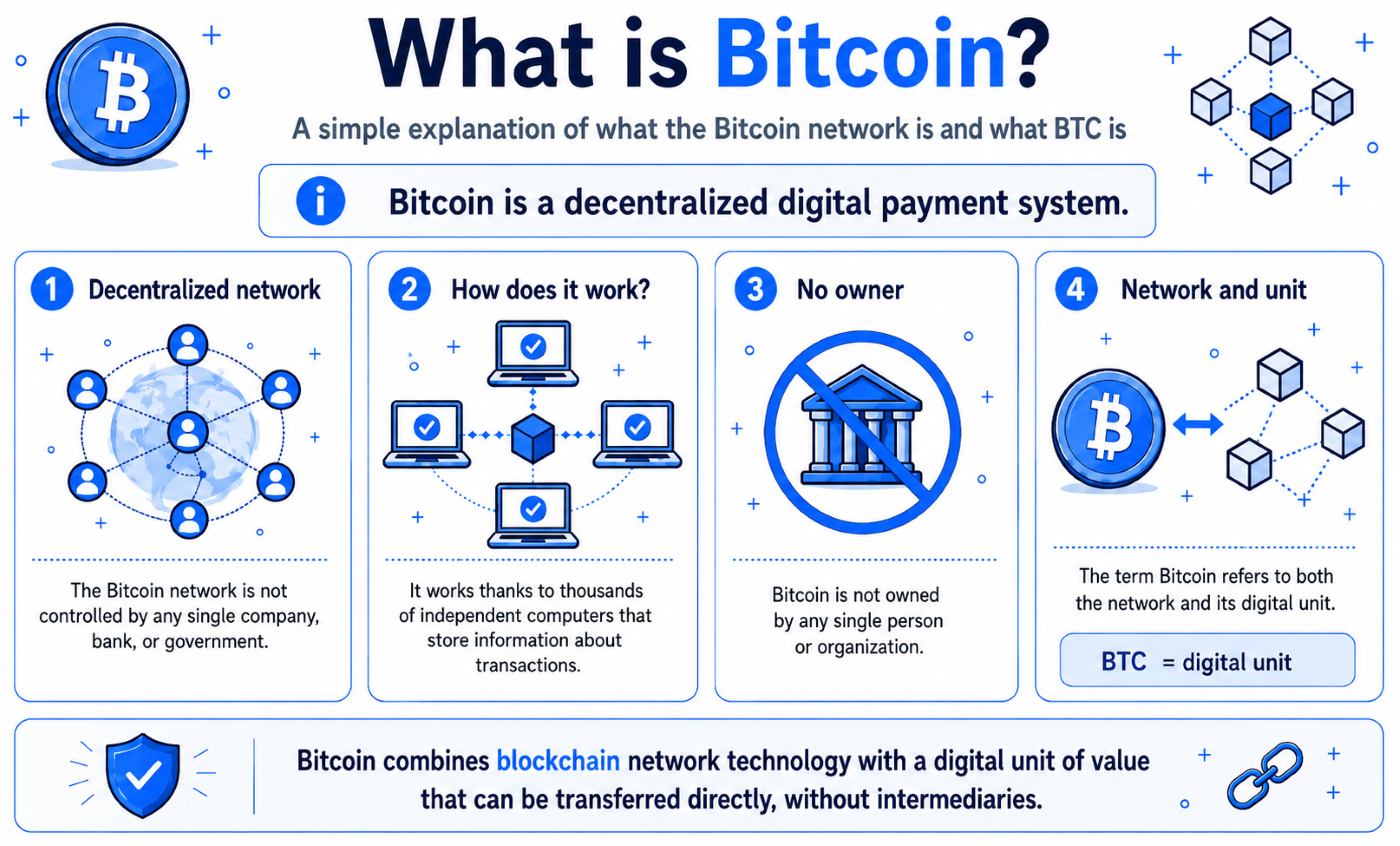
Bitcoin is a decentralized digital payment system and the cryptocurrency used within it, identified by the ticker BTC. It was designed to let users transfer funds directly to one another.
The Bitcoin network is not controlled by any single company, bank, or government authority. It is powered by thousands of independent computers that store transaction data and verify that transactions follow the protocol’s rules.
Bitcoin’s code is publicly available, and the rules governing the network are known to all participants. No one owns the entire system, and no single person can change its fundamental rules unilaterally.
The term Bitcoin refers to both the network and the digital unit used for payments. One bitcoin can be divided into 100 million smaller units, the smallest of which is called a satoshi.
Who created Bitcoin?
Bitcoin was created by a person or group using the pseudonym Satoshi Nakamoto. Their true identity has never been conclusively established.
In 2008, Satoshi Nakamoto published a paper titled “Bitcoin: A Peer-to-Peer Electronic Cash System”. It described an electronic payment system designed to operate without a trusted central authority.
The Bitcoin network launched in early 2009. Soon afterward, more developers and users joined the project. Satoshi Nakamoto gradually reduced their involvement and, around 2010, withdrew from the project’s development entirely.
Since then, Bitcoin has been developed by an international community of developers. Anyone can propose changes to the software, but their adoption depends on the network’s participants.
Why was Bitcoin created?
Bitcoin was created in response to the limitations of traditional electronic payments. A standard bank transfer or card payment usually involves a bank, payment processor, or another institution that authorizes and processes the transaction.
In the Bitcoin network, the intermediary’s role is replaced by protocol rules, cryptography, and a distributed network of computers.
The key problems Bitcoin was designed to address included:
- reliance on a central intermediary
- the risk of payments being blocked or restricted
- the difficulty of transferring value across borders
- the risk of the same digital funds being spent more than once
- the lack of predictable rules for issuing money
Bitcoin does not solve every financial problem. It does, however, provide an alternative system in which users can hold their own funds and decide when to send them.
How does Bitcoin work?
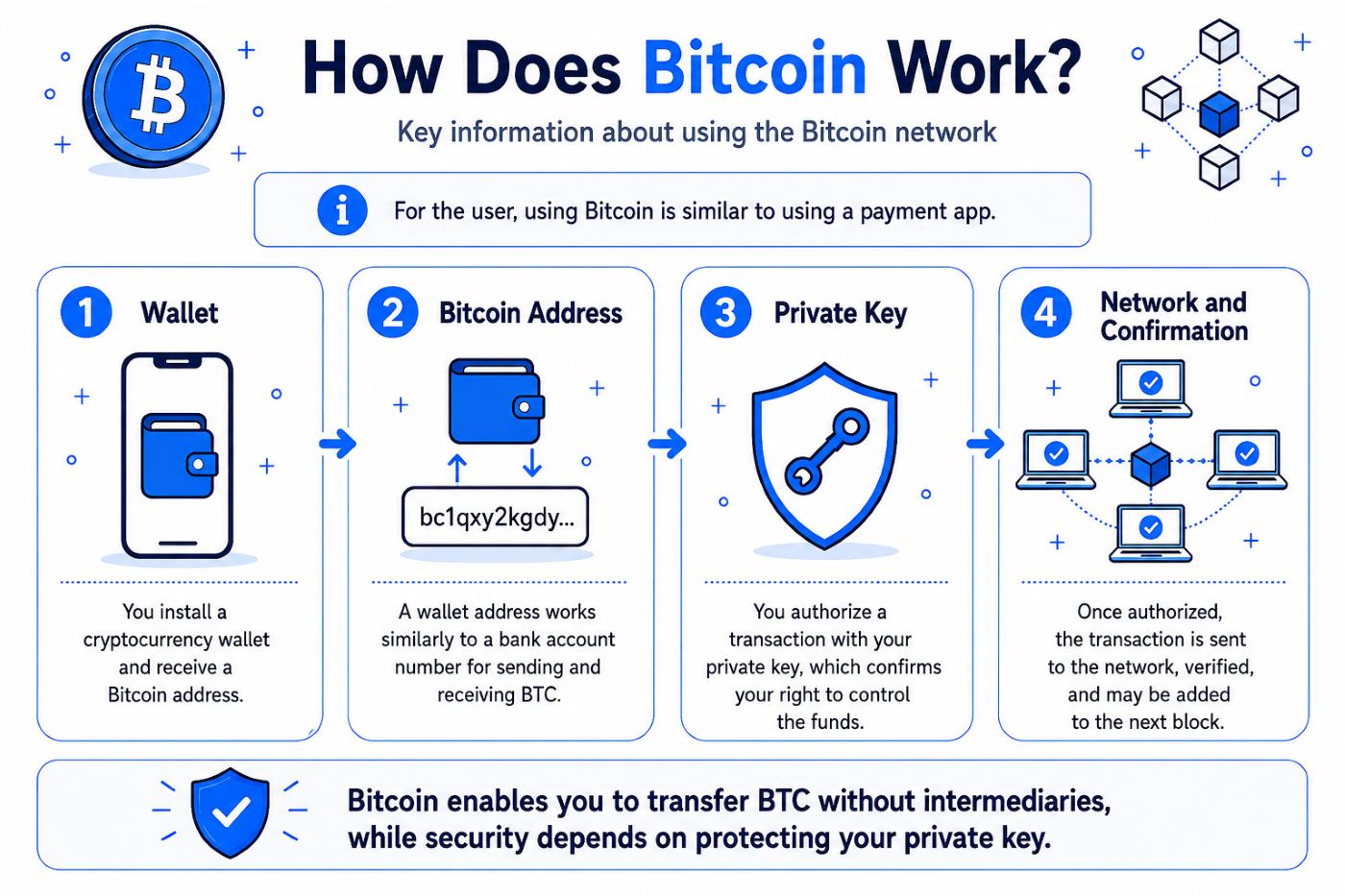
From a user’s perspective, using Bitcoin resembles using a payment app. The user installs a cryptocurrency wallet, receives a Bitcoin address, and can send or receive BTC.
A wallet address is similar to an account number to which funds can be sent. Transactions are authorized with a private key, which proves that the user has the right to control the bitcoins associated with the wallet.
A private key or recovery phrase should never be shared with anyone. Anyone who gains access to either can take control of the funds in the wallet.
Once authorized, the transaction is broadcast to the network. Network participants then verify it, after which it may be included in the next block of transactions.
What is the role of the Bitcoin network?
The Bitcoin network consists of computers that communicate directly with one another. Some operate as full nodes, which maintain a copy of the blockchain and independently verify that blocks and transactions follow the system’s rules.
Nodes do not have to trust a single central database. Each can independently verify the information it receives.
As a result, the network can continue operating even if some computers go offline or stop responding. There is no single server whose failure could bring the entire system to a halt.
The network is responsible for:
- relaying information about new transactions
- validating transactions
- verifying new blocks
- rejecting data that violates the rules
- maintaining a shared transaction history
Where does Bitcoin’s value come from?
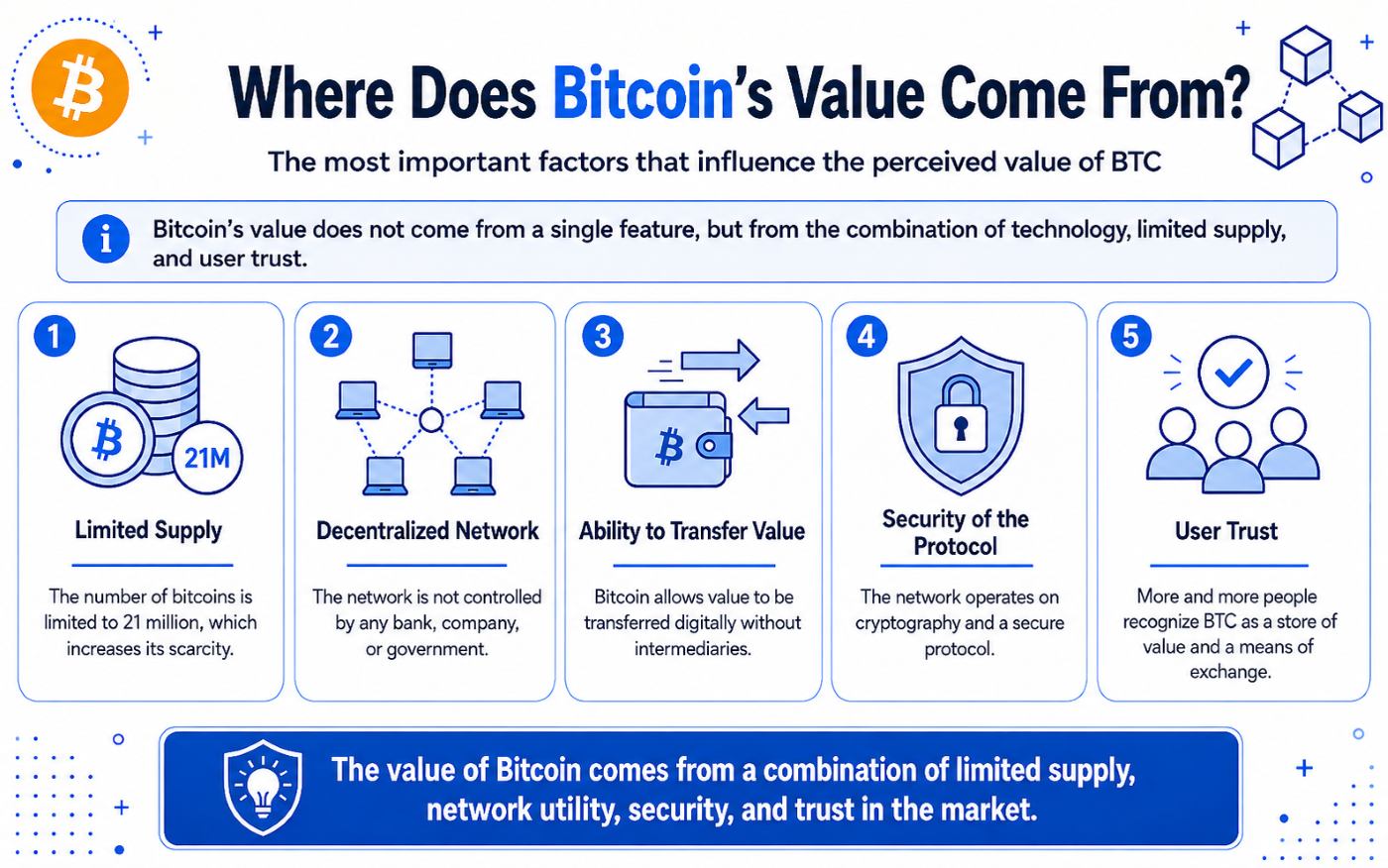
Bitcoin is not backed by gold or guaranteed by a government. Its value comes primarily from the fact that people want to own, transfer, and accept it as payment or hold it as a digital asset.
Several factors influence Bitcoin’s value.
Limited supply
The number of bitcoins cannot exceed the limit set by the protocol. This limited supply means Bitcoin is often compared with scarce assets such as gold.
Decentralized network
Bitcoin can operate without a central administrator. Users do not have to place control of the entire system in the hands of a single company or institution.
Ability to transfer value
Bitcoin can be sent to another wallet regardless of national borders. The recipient only needs a valid wallet address and an internet connection.
Protocol security
Transactions are secured with cryptography, and their history is verified by a distributed network.
User trust
As more people, companies, and services use Bitcoin, its practical utility may increase. Its value also depends on demand, market sentiment, and broader economic conditions.
How are new bitcoins created?
New bitcoins enter circulation as part of the reward for adding a valid block to the blockchain. A miner’s reward has two components:
- new bitcoins issued according to the protocol’s rules
- transaction fees from the transactions included in the block
The number of new bitcoins awarded per block is not constant. Approximately every 210,000 blocks, a halving occurs, reducing the block reward by half. In practice, this happens roughly once every four years.
Issuance therefore decreases over time. The maximum number of bitcoins that can ever be created is 21 million. Once issuance ends, miners are expected to earn primarily from transaction fees.
A predictable supply is one of the features that distinguishes Bitcoin from traditional currencies, whose supply can be increased by decisions made by central banks.
You can read more about how Bitcoins are created in the guide Cryptocurrency Mining in Switzerland – How Does It Work and Is It Profitable?
Why does Bitcoin matter?
Bitcoin demonstrated that it is possible to create a digital monetary system that operates without a central authority. It combined existing cryptographic methods in a way that solved the problem of double-spending digital funds.
For some users, Bitcoin is a payment method. Others treat it as a long-term asset, a hedge against the loss of value in traditional currencies, or a way to hold capital independently.
Bitcoin also matters because of its open nature. Anyone with suitable hardware and software can join the network. Users can also hold their own funds without entrusting them to a bank or exchange.
This independence also comes with responsibility. Losing a private key or recovery phrase can mean permanently losing access to a wallet.
Bitcoin price and future outlook
Bitcoin’s price is determined by supply and demand on exchanges and other trading platforms. No single central authority sets an official price.
Factors that may affect the price include:
- investor interest
- conditions in global markets
- regulatory decisions
- the growth of cryptocurrency-related services
- security incidents involving exchanges and wallets
- Bitcoin halvings
- announcements from companies and financial institutions
Bitcoin’s price can rise quickly, but it can also fall sharply. For this reason, its future price cannot be predicted reliably.
Price forecasts should be treated with caution. Even detailed analyses cannot guarantee a particular outcome.
Investing in Bitcoin: pros and cons
Buying Bitcoin can offer potential benefits but also involves serious risks.
Potential advantages |
Key disadvantages |
|---|---|
|
|
You should not use money needed to cover day-to-day expenses to buy cryptocurrencies. Before making a decision, learn how wallets work and understand the basic principles of storing BTC securely.
How to buy Bitcoin in Switzerland
Bitcoin can be bought in several ways: on a cryptocurrency exchange or through an online crypto exchange service, or at a Bitcoin ATM.
A Bitcoin ATM lets you buy BTC with cash. Before starting the transaction, prepare a cryptocurrency wallet with your own receiving address, which is usually displayed as a QR code.
A typical purchase works as follows:
- Select the option to buy Bitcoin on the ATM screen
- Scan the QR code from your wallet
- Insert cash into the ATM
- Review the amount and transaction terms
- Confirm the purchase
- Wait for the BTC to arrive in your wallet
The exact steps may vary depending on the ATM and the transaction amount, as well as the operator’s policies. Before confirming a purchase, always check the wallet address, exchange rate, and fee.
Is Bitcoin safe?
The Bitcoin protocol itself uses advanced cryptography and a distributed data-verification mechanism. However, this does not mean that every way of using cryptocurrency is automatically secure.
The most common risks involve user error, fake websites, investment scams, and inadequate wallet security.
To reduce these risks:
- only download wallets from official sources
- never share your seed phrase or private key with anyone
- double-check the address before sending BTC
- do not make a transaction at the request of someone you do not know
- be wary of promises of guaranteed, quick returns
Remember that a confirmed Bitcoin transaction usually cannot be reversed. If funds are sent to the wrong address, recovery may be impossible.
Summary
Bitcoin is a decentralized payment network and digital currency that enables users to transfer value without a bank. Transactions are recorded on a public blockchain and verified by independent computers around the world.
New bitcoins are created through mining, and issuance follows predictable rules. The maximum supply is capped, which is one reason Bitcoin is sometimes viewed as a scarce digital asset.
Using Bitcoin gives users a high degree of control over their funds, but also requires responsibility. Before making their first purchase, users should understand how their wallet works, secure their recovery phrase, and carefully check every transaction detail.
Frequently asked questions
Bitcoin is a decentralized cryptocurrency and a digital payment system. It allows users to transfer funds directly to one another without a bank or any other central institution.
Transactions are broadcast to the network, verified by its participants, and recorded on the blockchain. Users manage their funds with cryptocurrency wallets.
Bitcoin was created by a person or group using the pseudonym Satoshi Nakamoto. Their exact identity remains unknown.
The Bitcoin blockchain is a public ledger of all transactions made on the Bitcoin network. Data is recorded in successive blocks that form an ordered chain that is difficult to alter.
New bitcoins are created through mining. Miners use specialized equipment to secure the network and validate blocks of transactions.
The total supply of bitcoin is capped at 21 million. New units therefore cannot be created without limit.
The Bitcoin network uses cryptography and a distributed data-verification system. However, the security of your funds also depends on properly protecting your wallet and seed phrase.
In Switzerland, Bitcoin can be bought through a cryptocurrency exchange, an online crypto exchange service, or with cash at a Bitcoin ATM. A cryptocurrency wallet is required to receive BTC.